

What is refractive lens replacement?

Refractive lens replacement, also known as refractive lens exchange, is very similar if not identical to modern cataract surgery. It involves replacing your natural lens with a new artificial intraocular lens, usually a special multifocal or extended depth of focus lens, that lasts for life. The lens sits inside the eye behind the iris, the coloured structure of the eye that gives us our green or brown eyes, and is normally clear and transparent.

As we get older the lens loses its natural elasticity and ability to focus, a condition called presbyopia or dysfunctional lens syndrome. Later in life, the lens loses its normal transparency and optical properties; at this stage it is called a cataract.

Refractive lens replacement can achieve freedom from glasses. In addition to addressing presbyopia (the need for reading glasses), it can also achieve clear distance vision without glasses by correcting underlying refractive errors of the eye, such as short-sightedness, long-sightedness and astigmatism.

Laser eye surgery can achieve similar results and may be the preferred procedure, especially under the age of 55 years.

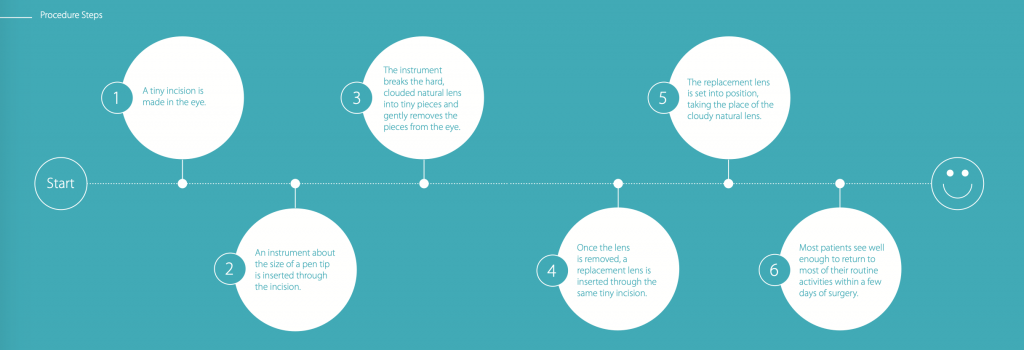
How is lens replacement performed?
How cataract _ RLE performed

Aris Konstantopoulos, Consultant Ophthalmic Surgeon
Cataract, Lens replacement and Laser Eye Surgery

Aris is a consultant eye surgeon at University Hospital Southampton NHS Foundation Trust. He runs private clinics at the Wessex Nuffield Health hospital (Chandlers Ford), Southampton Spire Healthcare hospital and Boots Opticians (Lymington, New Forest).

Read more

Why have surgery with Aris?

  • Experienced UK trained consultant eye surgeon
  • Personally performed thousands of operations
  • Broad range of vision correction procedures and experience enable Aris to recommend the treatment most appropriate to you
  • Personal care by Aris, from 1st consultation to surgery and follow-up
  • Surgery and aftercare within the safety of traditional private hospitals – the Nuffield Health and Spire Healthcare hospitals.

Painless 15 min procedure

Permanent vision correction

Return to work in 3-4 days

Affordable 0% finance

Contact us for a free, no obligation screening visit

Book now

What are the benefits of refractive lens replacement?

  • Refractive lens exchange with use of the appropriate lens during surgery, usually a multifocal lens with astigmatism correction (toric), can achieve freedom from glasses in 4 out of 5 patients.

  • It can improve the quality of your vision, restoring its natural sharpness.

  • It allows you to enjoy an active lifestyle more easily.

  • It eliminates the risk of infection that is associated with wearing contact lenses.

  • It provides the opportunity to reduce or eliminate your need for both distance and reading glasses. This refractive correction is achieved with the use of a customised lens that can compensate for any astigmatism you may have and also focus your eyes clearly for both distance and near.

  • It eliminates the need for cataract surgery in later life.

  • Your vision does not deteriorate with time and the benefits of lens replacement last a lifetime.

Laser surgery, lens replacement or cataract surgery?

  • In lens replacement and cataract surgery, the natural lens inside the eye is replaced with an artificial lens. Laser eye surgery is an external eye procedure that changes the shape and refractive properties of the cornea with laser.

  • The most appropriate procedure for you will depend on your refractive prescription, health of your cornea, transparency of lens and your age.

  • If you are happy with the quality of your vision and would like to be spectacle free, laser eye surgery would be the preferred option.

  • It you notice fading of colours and quality of vision and are generally older than 55 years, then lens replacement may be preferable.

  • All three procedures are great options, have an excellent safety profile and can achieve freedom from distance and reading glasses.

  • The key to a successful outcome is to identify the most appropriate procedure for your eyes and lifestyle needs at the medical consultation.

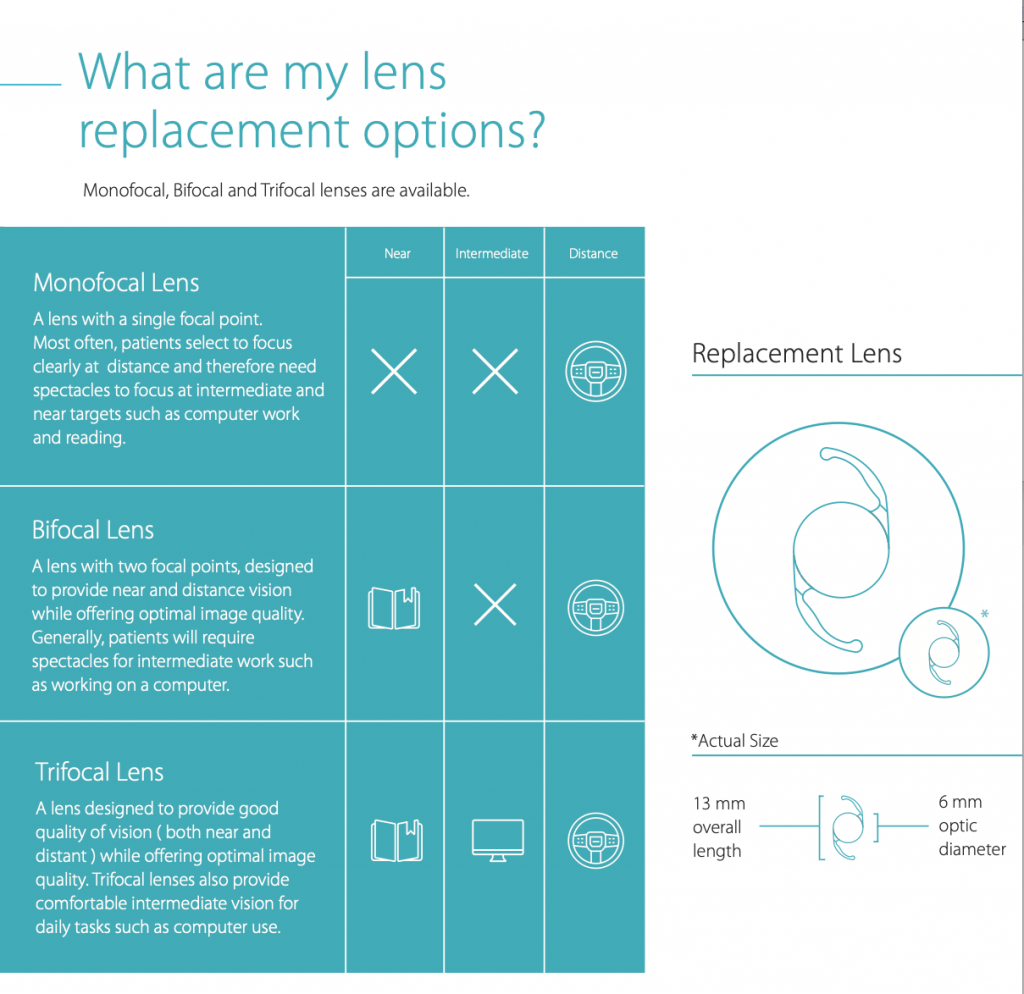
Lens options

Refractive Lens Replacement FAQs

Refractive lens exchange is generally recommended above the age of 55, especially when laser eye surgery is not indicated, for example due to a high prescription or thin corneas. It is a good option for the treatment of short-sightedness (myopia), long-sightedness (hyperopia) and astigmatism especially when there is a need for reading glasses.

Not all patients are suitable for all types of lenses (IOLs). Multifocal or extended depth of focus lenses may not be recommended if you have pre-existing eye conditions such as macular disease, glaucoma, an abnormal corneal shape or significant dry eye, as these can affect visual quality and increase the risk of unwanted visual side effects. Careful assessment in clinic and discussion of the available lenses and options can lead to a good outcome in the vast majority of patients.

  • In broad terms, lens (IOL) types and options include monofocal (single focus – usually for distance), multifocal and extended depth of focus lenses. All types are available in a toric variant to compensate for astigmatism that may be present.
  • All patients undergoing lens replacement or cataract surgery have a lens (IOL) that is matched to their eye. The calculation of the power of this IOL is based on the eye measurements that are taken during your clinic visit.
  • The type and power of the IOL will determine whether your natural vision (without glasses) is focused for distance, near or intermediate.
  • Lens replacement surgery can achieve distance, intermediate and near vision without the requirement for glasses most reliably with the use of a multifocal or extended depth of focus lens.

A multifocal lens is a great option if you are interested in achieving a more physiological range of vision for distance, intermediate and near. It can provide clear vision for distance, intermediate and near without glasses. The majority of patients can read small print following surgery, however a weak pair of glasses may be needed for prolonged reading in an environment with poor lighting. This lens can also be combined with astigmatism reduction by using a toric multifocal lens; this would allow you to achieve the best possible vision.

Very often the cornea is not a perfect sphere in shape, resulting in astigmatism; a toric lens (IOL) is used with lens replacement surgery to compensate for this astigmatism. A toric lens greatly reduces or eliminates the need for spectacles after surgery, whether a monofocal or multifocal IOL has been used, and provides better quality vision. Detailed topography scans (maps of the shape) of the cornea are required to assess your suitability and whether you require a toric IOL.

Astigmatism is a common condition that causes blurred vision. It is usually caused by the cornea not being perfectly symmetrical. Normally, the combined refractive efforts of the cornea and your natural lens focus light rays sharply on the retina of the eye. In astigmatism, the imperfect refractive properties of the eye result in an object not being sharply focused on your retina and thus blurred vision. With lens replacement surgery we can address corneal astigmatism with the use of a toric lens (IOL); this will provide greater quality of vision and the optimum result.

As with any surgical procedure, there are some risks with lens replacement, although serious complications are rare. These can include infection, inflammation, raised eye pressure, retinal detachment, or the need for further treatment to optimise vision.

Permanent serious vision loss is rare (less than 1 in 500 patients) and infection within the eye (endophthalmitis) is particularly rare, occurring in well under 1 in 2000 cases with the use of modern antibiotics during surgery. Approximately, 10-20 percent of patients with multifocal lenses may report haloes or glare in the early post-operative period, most commonly at night or in low-light conditions. These visual effects are mild and temporary, with symptoms reducing significantly over the first 3-4 months as the brain adapts to the new optical system through a process called neuroadaptation.

Lens replacement surgery is not painful. A pressure feeling may be experienced at times during the surgery, but not pain. You may notice shadows, movements, or kaleidoscope effect lights during the surgery, but you will not be able to see detail. A slight gritty sensation and sensitivity to light may be noticed for the first 24-48 hours after the procedure, particularly as your pupil may take a day or two to return to normal size (the pupil is dilated for the purposes of surgery).

Lens replacement surgery takes about 15 minutes per eye and is performed most usually with a local anaesthetic (numbing drops). We tend to perform surgery to both eyes at the same time. This speeds up the recovery process and allows your eyes and brain to adapt to the new optics more rapidly, a process called neuroadaptation.

The vast majority of patients require local anaesthesia for lens replacement surgery. Local anaesthesia is usually applied as eye drops before the operation. Once you have been given the anaesthetic you will still be awake and aware of what is happening, but you will feel no pain during the operation. If needed, sedation can also be used to reduce any apprehension or anxiety.

Local anaesthesia works very well at stopping you feel pain during the surgery and also offers pain relief after the operation. Generally, it has fewer risks and side effects than a general anaesthetic. You will recover more quickly and can go home on the same day. With local anaesthesia you can continue to take your usual prescribed medication and can eat and drink as normal after the operation.

When the operation starts you will see a bright light from the operating microscope. It is not unusual to see shadows, movements, or kaleidoscope effect lights during the operation, but you will not be able to see details of the operation. It is important that you look straight into this light and not move your eye by looking around. You will be aware that the surgeon is working and may feel pressure at times.

Lens replacement surgery is a simple and safe procedure requiring about 15 minutes per eye. The following sequence of steps is usually performed:

  1. Anaesthetic and antiseptic drops are applied on the outside of the eye.
  2. A tiny incision (less than 3mm) is made into the eye.
  3. An instrument smaller than a pen tip is inserted through the incision.
  4. The instrument emulsifies the natural lens into tiny pieces and gently removes the pieces from the eye. The lens is not removed completely – a supporting capsule is left in place.
  5. Once the natural lens is removed, a replacement lens (called the IOL) is inserted through the same tiny incision; the IOL sits on the supporting capsule.
  6. The replacement lens (IOL) is set into position, taking the place of the natural lens.
  7. All instruments are removed.
  8. No sutures are usually required.

Once you have recovered from surgery, you may go home after 30-60 minutes. You will have instructions about post-operative care and will be told about the medication you need to take. You will be shown how to put your eye drops in, if you are unsure what to do. Drops are used following surgery to reduce inflammation and to prevent infection.

Following surgery, the eye is generally comfortable, though a little scratchy. Your vision will be blurred for the first 24-48 hours, due to the surgery and a large pupil. It should then start to improve over the next few days. You may notice that the eye is slightly sensitive to bright light. If required, dark glasses may help with this sensitivity and glare.

You may be able to drive within 3 to 4 days of surgery. Following surgery, you are legal to drive as soon as you can see a number plate at 20 metres. However, at the same time your eye must not be sensitive to light or uncomfortable.

You will be required to use drops following the surgery, typically for a month. Do take the drops that you have been provided with and stay in a clean, dust-free environment for at least 1 week. Also wear a protective shield at night for the first week; this will stop you rubbing or touching the eye when asleep.

Do not get the eye wet for 1 week; a bath instead of a shower and assistance with washing your hair may be advisable. A visit to the hairdresser’s may also be an option. I generally advise not to wear make-up for 2 weeks and not to lift heavy weights or do strenuous exercise for 2 weeks. Swimming and the use of a sauna should be avoided for one month.

Typically, this is within 3 to 4 days of surgery. Following surgery, you are legal to drive as soon as you can see a number plate at 20 metres. However, at the same time your eye must not be sensitive to light or uncomfortable in any way. Your vision will be blurred for the first 24-48 hours, due to the surgery and large pupil. It should then start to improve over the next few days. You may notice that the eye is slightly sensitive to bright light. Wearing dark glasses may help with this sensitivity and glare.